Some links in this article may be affiliate links. See our disclosure for details.
LBMA Good Delivery Gold Bars: Standard and List Explained
By Thomas Lovas Lokoy | Last updated: September 6, 2026Researched and drafted with AI from published sources; edited and published by NorwegianSpark SA. Editorial policy.
The standard that decides whether a bar is money or metal
Two gold bars can contain the same weight of the same purity and be worth materially different amounts, because only one of them can be sold into the wholesale market without being tested first. The difference is accreditation, and in the London market the specific term for it is Good Delivery.
It is worth understanding for a reason that is not academic. Almost everything a retail buyer is told about "certified" or "investment-grade" gold is a downstream consequence of this standard, and knowing what it actually covers lets you tell a meaningful claim from a marketing one. Nothing here is financial advice.
What the London Bullion Market Association specifies
The specifications below are quoted from the LBMA's own Good Delivery Rules, technical specifications section, checked on 6 September 2026.
For gold bars: "Minimum gold content: 350 fine troy ounces (approximately 10.9 kilograms). Maximum gold content: 430 fine troy ounces (approximately 13.4 kilograms)." On purity, "the minimum acceptable fineness is 995.0 parts per thousand fine gold."
The required marks on a gold bar are a serial number, the stamp of the refiner, the fineness "to four significant figures", and — "For Bars produced from January 2019 onwards, the year and month of manufacture."
For silver, the same source gives a bar weight of "1000 troy ounces (approx. 32 kilograms) with a +/- 10% tolerance" and states that "the minimum acceptable fineness is 999.0 parts per thousand silver", with fineness "expressed to either three or four significant figures".
The LBMA's guide to the London market (lbma.org.uk, read 16 October 2026) adds the recommended dimensions of a gold bar — a top length of about 250 mm (±40 mm), a top width of about 70 mm (±15 mm) and a height of about 35 mm (±10 mm) — and states that gross weight is expressed in troy ounces in multiples of 0.025, rounded down.
| Good Delivery gold bar | Kilobar | One-ounce coin or small bar | |
|---|---|---|---|
| Gold content | 350–430 fine troy oz (about 10.9–13.4 kg) | 1 kg, about 32.15 troy oz | 1 troy oz or less |
| Minimum fineness | 995.0 parts per thousand | Set by the maker — read the stamp | Set by the mint or maker |
| Accepted in the London wholesale market | Yes | No — the LBMA lists kilobars as not acceptable | No |
| What "LBMA" on it can honestly mean | The bar meets the wholesale standard | The refiner may be accredited; the bar is not Good Delivery | The refiner may be accredited; the item is not Good Delivery |
Two things follow immediately from those numbers, and both surprise people.
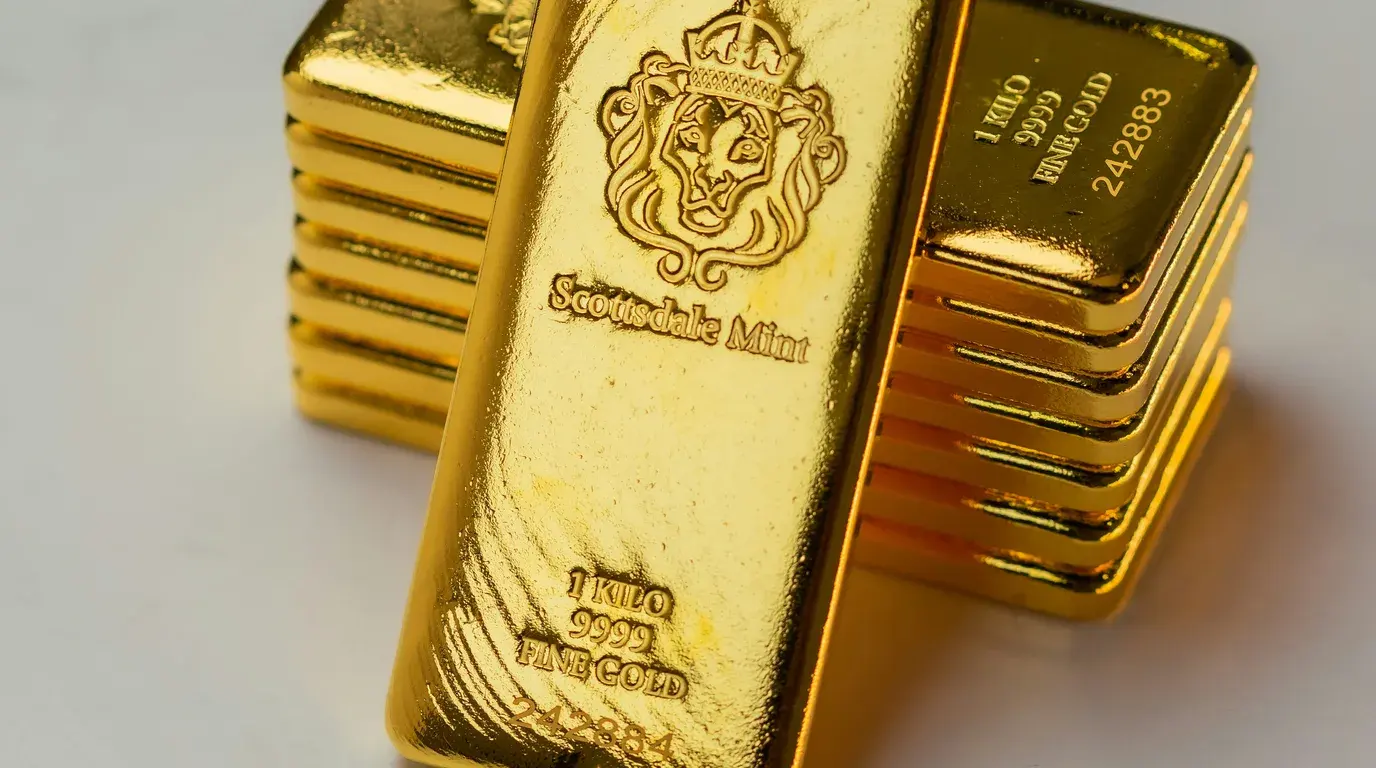
First: you almost certainly cannot buy a Good Delivery gold bar. The minimum is 350 fine troy ounces. That is a wholesale unit — the kind of bar that sits in a vault backing an exchange-traded fund, not something a retail dealer ships to a house. The LBMA's own FAQ is explicit that smaller formats are outside the wholesale standard, stating that "Bars such as kilobars, 100-ounce and smaller bars are not acceptable in the London wholesale market."
Second: the fineness minimum is lower than most retail gold. Good Delivery requires 995.0 parts per thousand. A great many retail coins and bars are 999.9. The wholesale standard is a floor for a market that settles by fine metal content, not an aspiration.
So what does it mean when a dealer says "LBMA"?
This is where the term gets stretched, and where a buyer can be misled without anyone technically lying.
The Good Delivery List is a list of refiners, not of products and not of dealers. The LBMA states on its own site that "Only refiners whose bars have been accredited by LBMA as meeting the exacting standards for trading on the global OTC market appear in the Good Delivery List" (lbma.org.uk, checked 6 September 2026). To be accepted, a refiner is assessed on its market history, financial standing, production capability and minimum output, must implement the LBMA's Responsible Gold Guidance and commit to its Responsible Sourcing Programme.
So when a retail one-ounce coin or a 100g bar is described as coming from an "LBMA-accredited refiner", that is a real and useful statement: it means the manufacturer has passed an assessment covering assaying competence, financial standing and sourcing. It is not a statement that the item itself is a Good Delivery bar, because by weight it cannot be. A dealer using "LBMA certified" to describe a small bar is describing the refiner's status, and a careful one will say so.
That distinction is worth carrying into every purchase. The accreditation you are benefiting from is of the maker, not of the object in your hand.
Why any of this reaches the retail buyer at all
The wholesale standard sets the terms for the market your metal will eventually be sold back into, and that flows downhill in three ways.
- Recognition reduces your sell spread. A dealer buying a bar from a refiner they know sits on the list has a lower verification cost, and verification cost is a component of the spread they quote you. The mechanics of that are in our guide to where to sell gold for the best spread.
- The chain of custody has value. A bar that has stayed within accredited storage and transport has a documented history. Once metal leaves that chain — sold privately, stored at home, packaging opened — a future wholesale buyer may require it to be assayed again before accepting it. That is not an accusation against you; it is the market's rule for metal it cannot vouch for.
- Sourcing assurance is part of the badge. The Responsible Sourcing requirement is a real part of the accreditation, and for buyers who care where their metal came from it is the most substantive assurance available in this market.
What Good Delivery does not tell you
Being clear about the limits is what makes the standard useful rather than a talisman.
- It says nothing about price. Accreditation is not a guarantee of a fair premium, and a dealer's invocation of it is not a pricing argument.
- It says nothing about the dealer. A refiner's accreditation transfers no assurance to whoever sold you the item. Vetting the counterparty is a separate exercise entirely — see how to choose a bullion dealer.
- It does not make an item immune from testing. Once packaging is opened or the chain is broken, a buyer may still assay.
- It says nothing about coins. Sovereign mint coins operate under their own government guarantee of weight and fineness, which is a different and equally strong assurance. Neither system supersedes the other.
- It is revocable and periodic. Listing is maintained through ongoing requirements. A brand that was accredited when a bar was made is not automatically accredited now, and vice versa. Refiners that stop meeting the standard, or stop producing Good Delivery bars, are transferred to the LBMA's Former Lists — worth checking alongside the current list when you look at an older bar.
The enforcement point is the vault door. The LBMA describes London's vault managers as "the gatekeepers of the London market": a bar that fails the requirements is rejected and returned to the refiner that produced it. That quality control is what a broken chain of custody loses, and it is why a bar that has left accredited storage may be assayed again before a wholesale buyer accepts it. If you hold metal through a vault, our vault storage guide explains the allocated contract that keeps it inside that chain.
How to use the standard in practice
- Read the bar. Serial number, refiner's stamp, fineness to four significant figures, and for anything made from January 2019 onwards, the year and month of manufacture. Those are the marks the standard requires; their absence on a bar claiming wholesale pedigree is a question.
- Check the refiner against the published list, which the LBMA maintains publicly for gold and for silver. Check the brand you were sold, not the brand the website's stock photography shows.
- Do not accept "LBMA approved" as a product claim. Ask which refiner, then verify the refiner.
- Keep the assay card with the bar and the serial numbers in your records. Everything the accreditation buys you at resale depends on the item still being identifiable.
- Leave the packaging sealed. The seal is what carries the chain forward to the next owner.
- For coins, look for the mint's own guarantee instead. Comparing recognised sovereign coins is a separate question — see Maple Leaf versus American Eagle and the sovereign versus the Krugerrand.
The counter-argument
A fair objection: for a retail buyer, this is a standard governing bars they will never own, administered by a trade association for the benefit of its own members, and it has been elevated into a marketing badge that now appears on packaging it was never designed to describe. There is truth in all of that. The accreditation is not consumer protection, it was not built for you, and treating it as a seal of retail quality is exactly the misunderstanding dealers benefit from.
The reason to know it anyway is defensive rather than aspirational. Understanding what Good Delivery covers is what lets you notice when the phrase is being used to mean something it does not. It tells you that the refiner passed an assessment and nothing whatever about the dealer, the price, or whether this particular object is what the label says. That is a narrow claim — and knowing exactly how narrow it is worth more than the badge itself.
For the practical grounding, see how to buy your first gold, and for what happens to the premium across a full round trip, premiums over spot.
FAQ
Can I buy a Good Delivery gold bar? Not realistically as a private buyer. The minimum content is 350 fine troy ounces, which is a wholesale unit.
Is 999.9 gold better than the 995.0 minimum? Purer, yes. Whether it is worth more per unit of fine gold is a separate question — wholesale settlement is by fine metal content, so higher fineness does not by itself create value.
Is a kilobar "Good Delivery"? No. The LBMA states that kilobars and smaller are not acceptable in the London wholesale market. A kilobar from an accredited refiner is still a well-made, widely accepted product.
Does an accredited refiner's bar still need testing when I sell? Often not, if the packaging is intact and the serial matches. Once the chain of custody is broken, a buyer may test regardless of the brand.
What happens when a refiner loses accreditation? It is moved to the LBMA's Former Lists. If you are buying or selling an older bar, check both the current and the former lists for the refiner named on it.
Precious-metals prices are volatile and capital is at risk. Nothing here is financial advice. See our disclosure for affiliate relationships.
Thomas Lovas Lokoy is the founder of NorwegianSpark SA, the Norwegian company (org. 834 984 172) that runs Aureum & Co. He oversees the business. Articles are researched and drafted with AI assistance; Thomas is responsible for what goes live. Corrections: thomaslien@norwegianspark.com.

Continue in this collection


Editorial Selection
More in Alternative Asset Managers
Unpaid editorial listings · star ratings are our own view
Blackstone
United States · Est. 1985
One of the largest alternative asset managers in the world, with semi-liquid vehicles (BREIT, BXPE) open to individual investors. Semi-liquid does not mean liquid — redemptions are capped and can be gated.
Minimums, fees and assets under management vary by mandate and change over time. We publish no figure for this firm because we hold none we can source and date — confirm terms with the provider directly.
KKR
United States · Est. 1976
Pioneer of the leveraged buyout, now a diversified alternative asset manager with growing individual investor access.
Minimums, fees and assets under management vary by mandate and change over time. We publish no figure for this firm because we hold none we can source and date — confirm terms with the provider directly.
Partners Group
Switzerland · Est. 1996
Swiss-listed alternatives firm offering direct private markets investing with a focus on value creation.
Minimums, fees and assets under management vary by mandate and change over time. We publish no figure for this firm because we hold none we can source and date — confirm terms with the provider directly.