Some links in this article may be affiliate links. See our disclosure for details.
Premiums Over Spot, Honestly Explained
By Thomas Lovas Lokoy | Last updated: September 6, 2026Researched and drafted with AI from published sources; edited and published by NorwegianSpark SA. Editorial policy.
Why your gold cost more than the gold price
You looked up the spot price, worked out what an ounce should cost, opened a dealer's site and found a bigger number. Nobody is cheating you. The difference has a name — the premium over spot — and understanding how it is built is the single most useful piece of knowledge a physical metal buyer can have, because the premium is the part of the price you have any control over.
Spot is the price of unallocated metal in the wholesale market, quoted for large quantities, in a form and location that professional counterparties accept. It is a reference for a thing you cannot buy. What you can buy is a specific, manufactured, authenticated, insured, delivered object. Everything between those two states is the premium.
No premium figure appears in this article. Premiums move with mint output, dealer inventory, freight cost and retail demand, and a percentage written today can be wrong within weeks — sometimes within days during a demand spike. What does not change is how the premium is assembled, and that is what you can use to judge whether a specific quote is fair. Nothing here is financial advice.
What the premium is actually paying for
Take the difference apart and it is not one charge. It is a stack, and different products load different layers.
- Refining and fabrication. Turning wholesale metal into a bar or a blank costs a fixed amount per item. That fixed cost is spread across whatever the item weighs, which is why the same metal costs proportionally more in small pieces.
- Minting and design. A struck sovereign coin costs more to produce than a poured bar. A proof or commemorative finish costs more again.
- Sovereign guarantee and legal-tender status. A government mint's coin carries an official assurance of weight and fineness. Buyers pay for that assurance because it reduces what a future buyer has to verify.
- Packaging and assay documentation. A sealed card with a matching serial number is not decoration; it is the thing that lets the next buyer skip an assay.
- Distribution. Wholesale allocation, freight, fully insured shipping, and the dealer's cost of holding stock in a market where the value of that stock moves every minute.
- Dealer margin. Genuinely earned, because someone has to carry inventory risk and fund the buy-back promise.
- Scarcity, at the moment you buy. When retail demand spikes, mints cannot expand output quickly. The queue is priced, and it is priced into the premium rather than into spot.
That last item is why premiums widen in exactly the conditions that make people want to buy. A demand shock does not just move the metal price; it moves the cost of turning metal into a coin somebody will sell you today.
How the stack differs by product
| Product type | Fixed costs spread over | Typical premium driver | Who it suits |
|---|---|---|---|
| Large cast bar | A lot of metal | Almost purely fabrication and distribution | Lowest cost per ounce; hardest to sell in part |
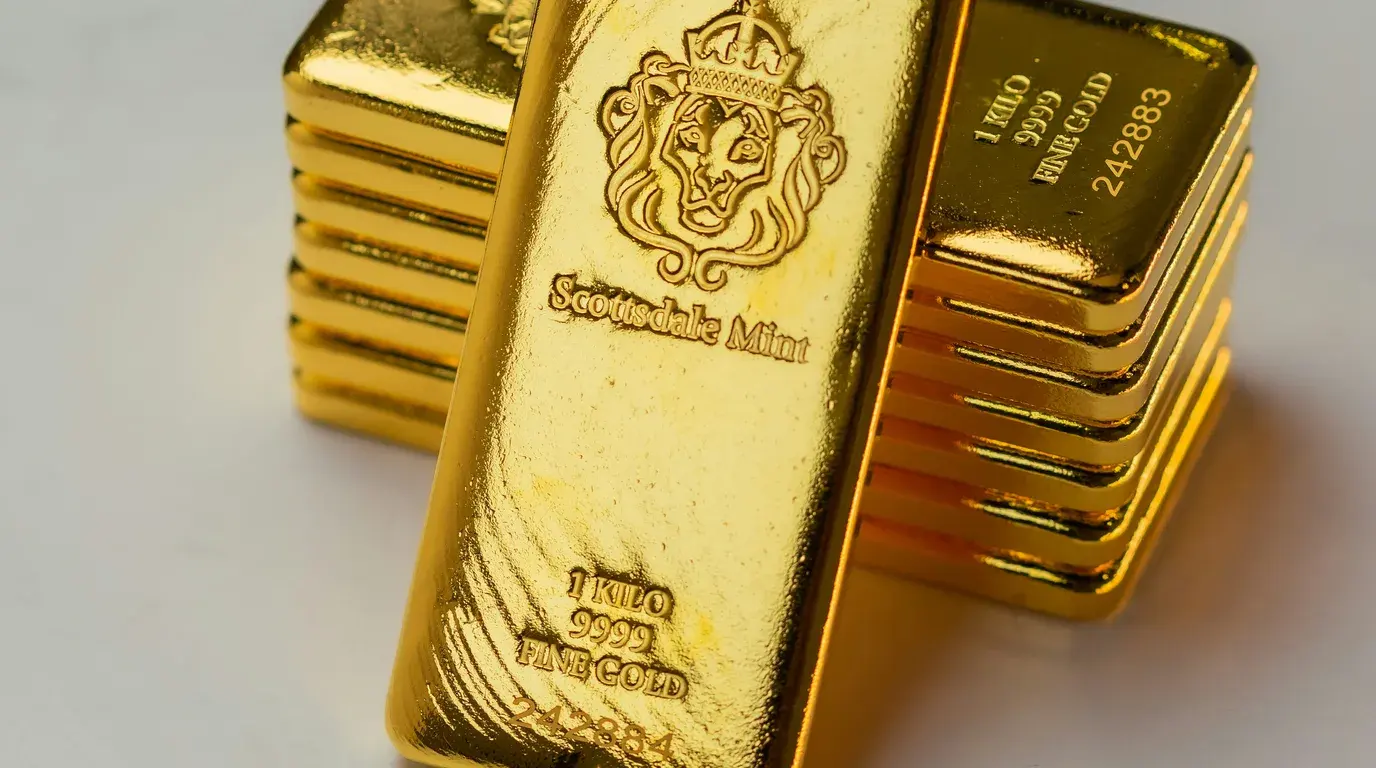
| Kilo or minted bar | A moderate amount of metal | Fabrication plus packaging and assay card | Balance of cost and divisibility |
| One-ounce sovereign coin | One ounce | Minting, sovereign guarantee, recognition | Best resale recognition per unit of cost |
| Fractional coin | A fraction of an ounce | The same fixed minting cost over far less metal | Divisibility, at a materially higher cost per ounce |
| Proof or commemorative | One coin | Finish, packaging, limited issue | Collectors, not bullion buyers |
The pattern is one rule with several faces: fixed costs divided by less metal means a higher premium per ounce. Everything in that table follows from it. It is also why the cheapest way to own an ounce and the most useful way to own an ounce are rarely the same product — a point our comparison of gold bars versus coins works through in detail. The same fixed costs reappear when you sell, which is why the buy-back side deserves its own look: see where to sell gold for the best spread.
The mistake that costs most
The common error is optimising the buying premium in isolation. A large bar bought at the lowest available premium looks like the winner right up to the moment you want to release part of the position, at which point you discover you must sell all of it or none. Meanwhile the coin buyer who paid a higher premium can sell exactly what they need.
The second error is treating the premium as sunk. It is not — some of it comes back. A widely recognised sovereign coin in original packaging is bid closer to spot when you sell than an obscure private-mint bar with no assay card, because the dealer's costs of authenticating and reselling it are lower. Part of what you paid at purchase is bought back at sale in the form of a narrower spread. That is why the real question is never "what premium am I paying" but "what is the round trip?"
Working out the round trip before you buy
Ask any dealer these five questions before committing. They are all answerable, and a dealer who will not answer them has told you something.
- What is the premium on this product today, expressed against the live spot price?
- What are you bidding for the same product today, expressed against the same spot?
- Is that buy-back price conditional on the original packaging and assay card being intact?
- Do you publish your buy-back prices, or are they quoted on request?
- What are the shipping, insurance and payment charges on top of the quoted price?
The gap between the first two answers is the round trip, and it is the number that decides how far the metal price has to move before you are even. A product with a slightly higher buying premium and a much narrower sell spread is frequently the better purchase, and no headline premium comparison will ever show you that.
The things that make premiums move
- Mint output. Sovereign mints run to production schedules. When retail demand exceeds their capacity, dealers ration and premiums rise on the affected products specifically, not on metal generally.
- Which product is in shortage. Premiums do not move together. A squeeze on one government coin can leave bar premiums unchanged.
- Dealer inventory position. A dealer long on a product will price to move it. This is why quotes differ across dealers on the same day for the same item.
- Freight and insurance costs. These feed straight through, and they are not stable.
- The retail buying cycle itself. Premiums are widest when the largest number of people want to buy, which is the worst moment to be inflexible about which product you will accept.
That last point has a practical consequence. If you are buying into a spike and the premium on your preferred coin has widened sharply, a different recognised product frequently offers the same metal at a materially better total price. Flexibility about form is worth more than patience about price for most buyers.
The honest limits, and the counter-argument
There is a legitimate argument that the whole premium discussion is a distraction. Over a long holding period, the metal price does far more to your outcome than a couple of percentage points paid at purchase, and buyers who spend weeks optimising the premium frequently miss larger moves in spot while they are shopping. That criticism lands.
But it lands only for large positions held for a long time. For a small holding, for fractional products, or for anyone who may need to sell within a few years, the round-trip cost is a substantial fraction of the whole outcome and cannot be waved away. The correct weighting is therefore not "premiums do not matter" or "always buy the lowest premium", but: the shorter your horizon and the smaller your position, the more the round trip matters, and the more you should prefer a recognised product with a narrow sell spread over the cheapest headline premium.
For what a specific holding is worth today, use our gold calculator. For how weight and fineness turn into a value in the first place, see how to calculate gold value. For which coins carry the strongest recognition, see Maple Leaf versus American Eagle and the sovereign versus the Krugerrand. And before you pick a counterparty at all, read how to choose a bullion dealer.
FAQ
Is a lower premium always better? No. A low buying premium with a wide sell spread can cost more over the round trip than a higher premium with a narrow one. Compare both sides.
Why do two dealers quote different premiums on the same coin? Different inventory positions, different wholesale allocations, different freight and different margin policy. Getting more than one quote is worth the ten minutes.
Does the premium come back when I sell? Partly, and only on products the market recognises. Original packaging and an intact assay card are a large part of what preserves it.
Are fractional coins a mistake? Not if you value divisibility, which is a real benefit. They simply cost more per ounce, and you should choose them knowing that rather than discovering it.
Precious-metals prices are volatile and capital is at risk. Nothing here is financial advice. See our disclosure for affiliate relationships.
Thomas Lovas Lokoy is the founder of NorwegianSpark SA, the Norwegian company (org. 834 984 172) that runs Aureum & Co. He oversees the business. Articles are researched and drafted with AI assistance; Thomas is responsible for what goes live. Corrections: thomaslien@norwegianspark.com.

Continue in this collection

Editorial Selection
More in Alternative Asset Managers
Unpaid editorial listings · star ratings are our own view
Blackstone
United States · Est. 1985
One of the largest alternative asset managers in the world, with semi-liquid vehicles (BREIT, BXPE) open to individual investors. Semi-liquid does not mean liquid — redemptions are capped and can be gated.
Minimums, fees and assets under management vary by mandate and change over time. We publish no figure for this firm because we hold none we can source and date — confirm terms with the provider directly.
KKR
United States · Est. 1976
Pioneer of the leveraged buyout, now a diversified alternative asset manager with growing individual investor access.
Minimums, fees and assets under management vary by mandate and change over time. We publish no figure for this firm because we hold none we can source and date — confirm terms with the provider directly.
Partners Group
Switzerland · Est. 1996
Swiss-listed alternatives firm offering direct private markets investing with a focus on value creation.
Minimums, fees and assets under management vary by mandate and change over time. We publish no figure for this firm because we hold none we can source and date — confirm terms with the provider directly.